GPTZero Review 2026: Is It Still the Best AI Detector?
This is my honest GPTZero review after running it across a real agency workflow — not just a quick test. I run a digital agency, and AI-generated content runs through our workflow every single day — from client blog posts to internal docs. That means AI detection tools aren’t optional for us; they’re part of quality control. GPTZero is the one I’ve relied on most, and it’s also the one I trained my whole content team to use before anything goes out the door.
This review covers what GPTZero actually does well, where it falls short based on what I’ve seen in daily use, and whether it’s worth paying for in 2026.
What Is GPTZero? (GPTZero Review: Core Features)
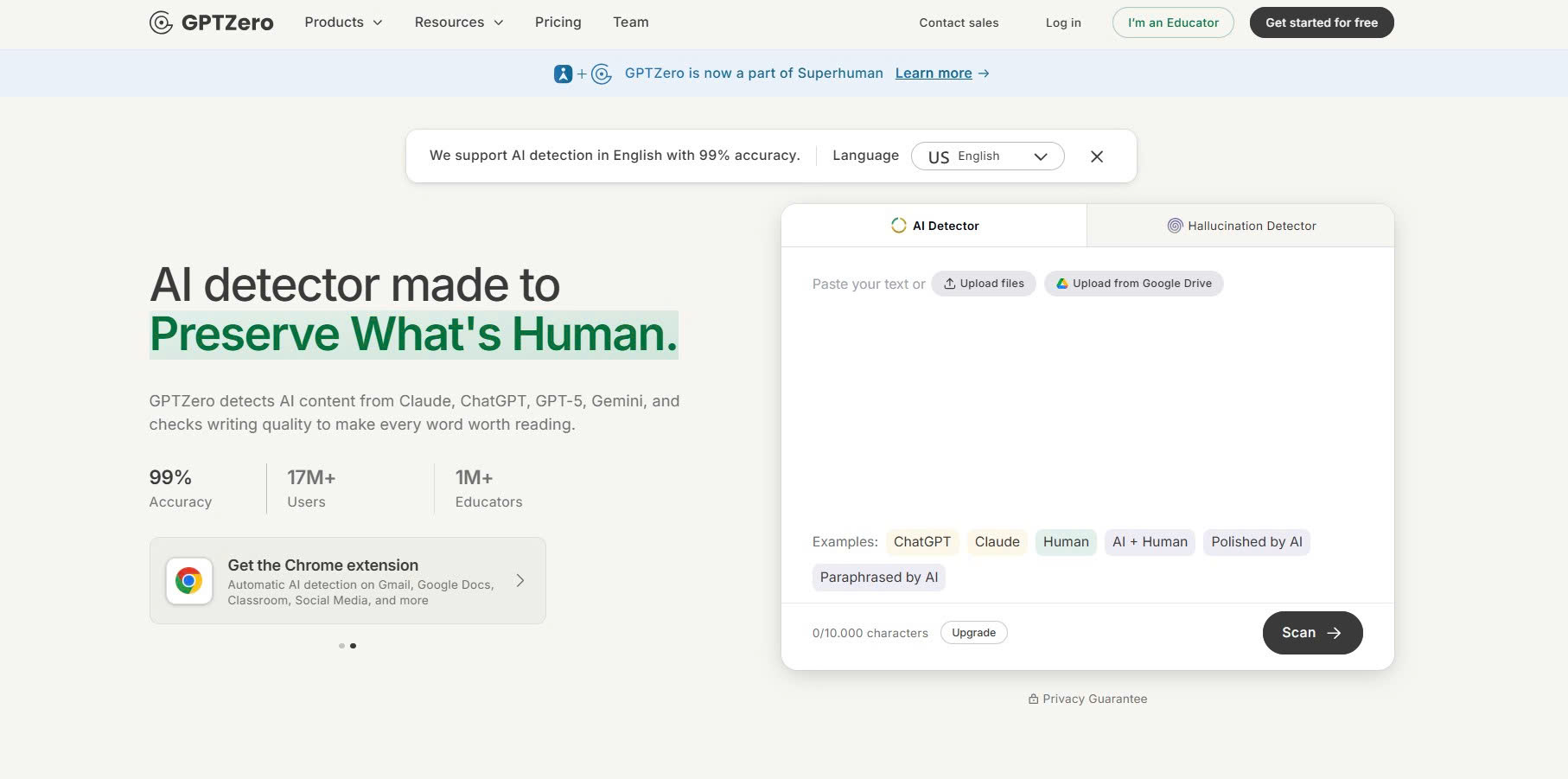
GPTZero scans text and returns a probability score for how likely it is to have been written by AI. It works on essays, articles, emails, and other long-form writing, and it’s trained to recognize output from major AI model families — OpenAI, Anthropic, Google, Meta, and Mistral — at comparable accuracy across all of them.
Beyond a basic AI/human score, GPTZero offers a few features my team actually uses day to day:
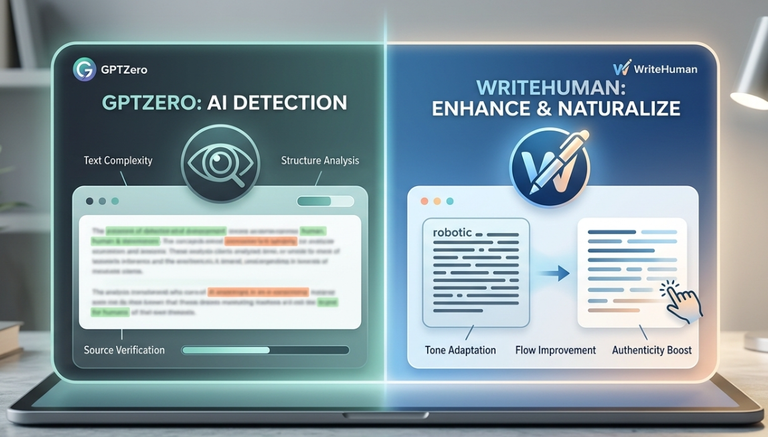
- Sentence-level highlighting — shows exactly which sentences are flagged, not just one overall percentage. This is the feature I point new hires to first, because it turns “this is 60% AI” into something they can actually act on
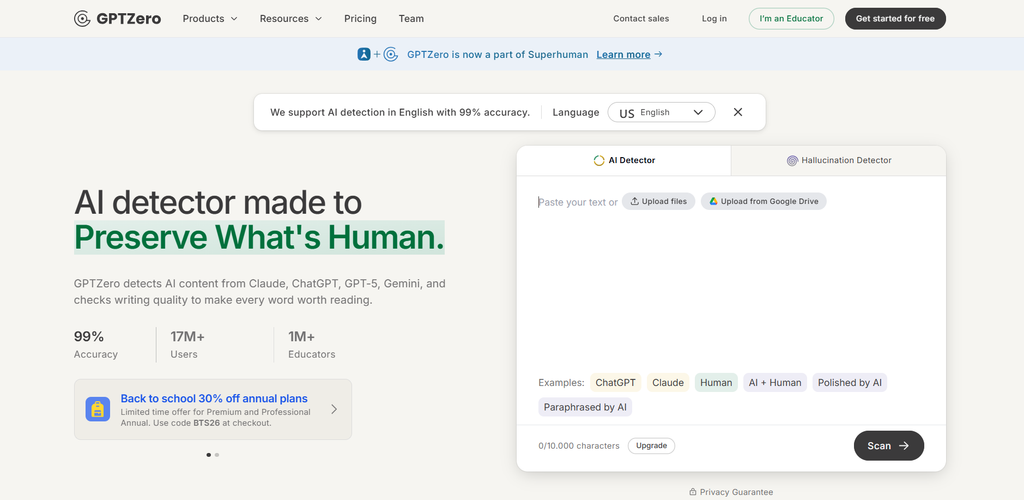
- Writing Process analysis — available in its education product, this looks at how a document was written over time (revision history, typing patterns) instead of judging only the finished text. Process evidence is much harder to fake than style alone, which is the core weakness of most detectors in this category
- Plagiarism checking bundled into paid plans
- A Chrome extension for quick checks without leaving your browser
- API access on the Professional tier — this is the one we actually use internally, since it lets us build detection straight into our content pipeline instead of copy-pasting into a dashboard every time
How It Works (Step by Step)
This is roughly the workflow I taught my team when we rolled GPTZero out company-wide:
- Paste or upload your text — GPTZero accepts pasted text directly or file uploads (Word, PDF) depending on your plan
- Run the scan — the engine analyzes the text across multiple signal layers, not just word-choice patterns
- Read the sentence-level report — rather than one number, you get a breakdown showing which specific sentences are flagged as likely-AI, likely-human, or mixed
- Check the Writing Process tab (education accounts) — see the revision history and typing cadence behind the document, if it was written inside a supported editor
- Export or share the report — useful for documenting a case internally, or showing a client their content passed review before it goes live
Pricing
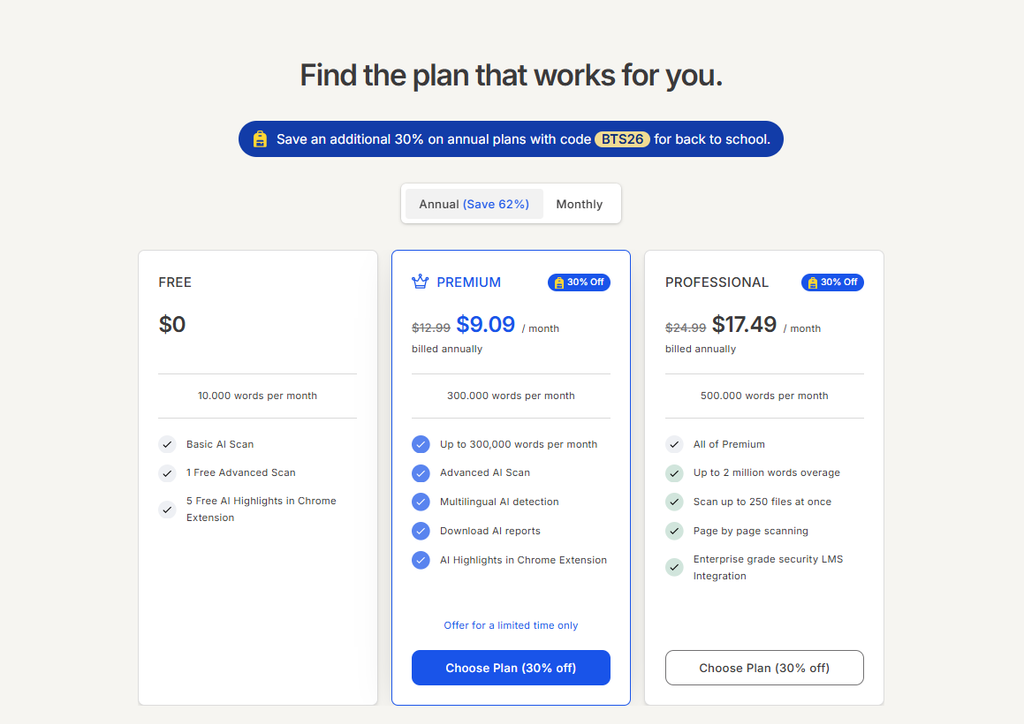
| Plan | Monthly Price | Annual Price | Word Limit | Notes |
|---|---|---|---|---|
| Free | $0 | $0 | 10,000 words/month | No credit card, no expiration |
| Essential | $14.99/mo | ~$8.33/mo | 150,000 words/month | AI Vocabulary, Chrome extension, plagiarism check |
| Premium | $23.99/mo | ~$12.99/mo | 300,000 words/month | Unlimited hourly scans |
| Professional | $45.99/mo | — | 500,000 words/month | API access, reporting |
Annual billing cuts the price by roughly 45% across paid tiers — a detail worth factoring into any GPTZero review, since it changes the real cost significantly if you’re committing long-term. There’s also a separate Classroom tier (LMS integrations — Canvas, Google Classroom, Moodle — plus admin dashboards) and an Enterprise API tier, both priced per-institution rather than listed publicly.
For an agency running content at any real volume, I’d skip the free tier fast — 10,000 words a month gets used up quickly once you’re checking every deliverable, not just a sample.
How Accurate Is It, In My Experience?
GPTZero has topped several independent benchmarks — including a widely-cited 2026 Chicago Booth study that put it at 99.5% accuracy with a 0.05% false-positive rate, ahead of most named competitors in that test. That tracks with what I’ve seen running it across a real content pipeline, not just isolated test samples.
That said, “best in benchmark” doesn’t mean flawless in practice. Weak spots I’ve personally run into with my team:
- Non-native English writing — a few of my writers aren’t native English speakers, and their phrasing has occasionally triggered false positives. I’ve learned to treat a flag on their work as a “double-check,” not a verdict
- Heavily-edited human prose — text that’s been through multiple human rounds of editing can occasionally read as “too clean” to the model
- Highly-formulaic writing — structured, template-like content can score higher on AI-likelihood even when written entirely by a human
- Humanized AI text — content run through a humanizer tool (see our WriteHuman review) is, by design, harder to catch
The practical rule I’ve trained my team on: treat any single GPTZero score as one data point, not a verdict — especially before it affects a client relationship or someone’s work getting rejected.
Who Should Use GPTZero (and Who Shouldn’t)
Good fit for:
- Agencies and content teams that need a fast, repeatable QA step before publishing
- Individual teachers who want a free, no-signup-hassle way to spot-check student work
- Teams that need to show clients their deliverables pass a credible AI check
- Schools and universities that need LMS-integrated detection at scale (Classroom tier)
Probably not the best fit for:
- Anyone who needs anonymous, no-account scanning — GPTZero requires signup even on the free tier
- Teams that need a short paid trial before committing — there isn’t one beyond the permanent free tier
- Situations where a single false positive would be extremely costly and you have no backup verification process — in that case, use GPTZero alongside a second opinion, not alone, which is exactly how we run it internally
Pros and Cons
Pros:
- Most generous free tier in the category, and it never expires
- Sentence-level detail instead of a single opaque score — genuinely easier to train a team on
- Writing Process feature adds a harder-to-fake second layer of evidence
- Strong LMS integrations for institutional use
- Trained to detect output across all major AI model families, not just one
Cons:
- Requires signup even for the free tier — no anonymous scanning
- Accuracy drops on humanized, heavily-edited, or non-native-English text — same weakness as every detector in this category, just worth knowing going in
- No short trial period for paid tiers beyond the permanent free plan
- Text you submit is retained in your dashboard, which matters if you’re scanning sensitive or unpublished client material
GPTZero vs. the Alternatives
GPTZero isn’t the only detector I’ve tried, and the right pick depends on what you’re actually optimizing for:
- vs. Turnitin — Turnitin is more common in institutional settings and its core strength is plagiarism checking first, AI detection second. GPTZero is built AI-detection-first, with plagiarism as an add-on.
- vs. Originality.ai — Originality.ai leans harder toward content marketing and SEO teams managing high volumes of AI-assisted content, with team-oriented workflows. GPTZero’s free tier and classroom tools give it the edge for individual users and educators.
- vs. Copyleaks — Copyleaks is cheaper at the entry tier (around $7.99/mo) and bundles in code and plagiarism detection, which makes it worth a look if you need more than just AI-text scanning.
For a detailed head-to-head on how GPTZero holds up against AI-humanized text specifically — the scenario where detectors get tested hardest — see our full GPTZero vs. WriteHuman comparison.
FAQ
Is GPTZero free to use? Yes — the free plan covers 10,000 words per month with no credit card required, and it doesn’t expire.
Is GPTZero better than Turnitin? They’re built for different primary jobs. GPTZero focuses on AI detection; Turnitin’s core strength is plagiarism checking. Many institutions actually use both.
Does GPTZero save the text you submit? Yes — submitted text is retained and accessible in your dashboard under the Documents tab. Worth knowing if you’re scanning sensitive or unpublished content.
Can GPTZero detect text that’s been “humanized”? It’s harder, but not impossible. Detection accuracy drops on text run through a humanizer tool, since that’s specifically what those tools are built to defeat. See our GPTZero vs. WriteHuman comparison for real test results.
Does GPTZero work on languages other than English? GPTZero is primarily optimized for English-language detection; accuracy on other languages is less consistently benchmarked.
Verdict: Final Word on This GPTZero Review
After running this across a real agency workflow — not just a one-off test — GPTZero remains one of the strongest all-around AI detectors in 2026, particularly if you want a free tier that’s actually usable rather than a crippled trial. It’s not flawless — nothing in this category is — but for teams that need a fast, credible first-pass check, it’s the one I’ve kept coming back to, and the one I trained my own staff on.